


We create solutions that tell stories, shape flows and connect physical environments with digital interaction. We do this partly by building the foundation itself in the form of stable, robust and fast infrastructure, and partly through solutions and services that help our customers make full use of that infrastructure.
In our work, we often collaborate closely with creators, producers and various technical partners in order to deliver experiences that are as immersive and memorable as possible. This has given us the experience and capability to take overall responsibility at the intersection of different disciplines and specialist competencies. It also means that we have a deep understanding of the interplay between creative vision and the technology that makes it possible.
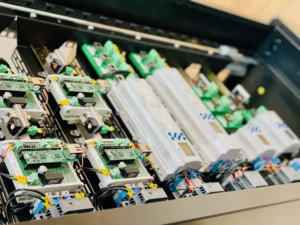
User-friendly and robust solutions
The experience industry places its own specific demands on technology. It needs to withstand interaction with visitors day after day. Public environments also create a risk that users will handle the technology contrary to instructions and expose materials to intentional or unintentional damage. Our long experience of installations in demanding environments gives us the knowledge to build installations that are as robust as the experience they are intended to deliver. The technology also needs to be intuitive and easy to use, so that it can be handled by staff without extensive experience or specialist knowledge.
When we develop networks and technology for experiences, we always do so with the future in mind. Our technology should not only enable an experience, but also be prepared for ongoing development, adjustment and expansion. It is built to evolve alongside the customer’s reality, and we remain involved as support and guidance throughout the process.
If the client wishes, the technology can also be used to collect information on, for example, usage, flows and behaviour. This can provide invaluable decision support and indicate how the experience can be adjusted and developed to perform even better.
We expect the unexpected
However reliable our technology may be, we are always prepared in case something unexpected happens. That is why we always build in remote access, enabling us to provide service, support and troubleshooting at a distance, naturally combined with full on-site support whenever needed. When we create the reason for a visit, it is business-critical that the technology works. A technical problem that causes downtime is more than an inconvenience. It is a ruined experience for the visitor, one that leads not only to lost revenue but also to reduced trust, which today can spread quickly, for example through social media.
TPO offers different types of business models adapted to the experience industry, in order to match the needs and conditions of each project as effectively as possible. Hardware can be rented, leased or purchased, and services can be billed on an ongoing basis or packaged within the framework of an agreement. All so that you, as the customer, can define the required functionality while we focus on finding a cost-effective and reliable solution.
TPO helps you by:
- Creating technical solutions that connect physical environments and digital interaction for immersive experiences
- Building stable, robust and fast infrastructure as the foundation for the experience
- Working closely with creators, producers and technical partners
- Taking overall responsibility at the intersection of creative vision and technology
- Developing solutions that are robust, reliable and adapted to public environments
- Building technology with future development, expansion and change in mind
- Ensuring high availability through remote monitoring, support and on-site service
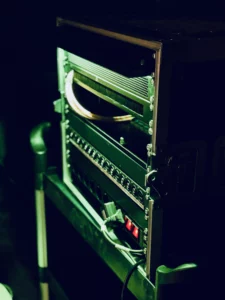
System Integration
Many of our assignments are fundamentally about getting different technical systems to work together as one cohesive whole. In modern environments, such as the experience industry, public settings and larger fixed installations, it is rarely enough for individual systems to work in isolation. Sound, video, lighting, control systems, networks and user interfaces must interact in a reliable and predictable way.
Systems integration becomes relevant when multiple technical disciplines need to work together in practice. This can involve everything from coordinating sound, video and lighting in public environments to interactive installations where visitors influence the experience through buttons, sensors or their own mobile devices. We always aim for the user to experience the whole as intuitive and self-evident, even when the underlying technical complexity is high.
Availability and security
Our role in these projects is to tie the whole together. We ensure that different systems are connected in a structured, secure and well-documented way, always with the network as a stable foundation. This means the solutions can be scaled, monitored and secured even across greater geographical distances, with clear requirements for availability and operational reliability.
An increasingly important part of systems integration is cybersecurity and risk management. Digital threats, outages or data loss can have major consequences in operations where technology is business-critical. That is why we design integrated systems with redundancy, backup and recovery capabilities. By placing intelligence and data in the right place, we can create solutions that remain robust even in the event of incidents, and that make it possible to resume operations quickly from the point at which an interruption occurred.
For you as a customer, systems integration means a solution in which technology does not become an obstacle, but a tool. We create integrated technical solutions where each part has its place and purpose, and where the result is stable, secure and built for long-term use.
TPO helps you by:
- Getting multiple technical systems to function together as a whole
- Integrating sound, video, lighting, control systems, networks and user interfaces
- Ensuring reliable and predictable operation in complex environments
- Taking responsibility for structure, security and documentation in the integration
- Integrating cybersecurity, risk management and operational reliability from the outset
- Incorporating redundancy, backup and recovery capabilities
- Designing systems for rapid recovery in the event of incidents
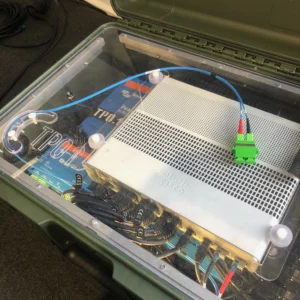
Signal Distribution
Signal distribution is about delivering the right information to the right place at the right time. In modern installations, the network is increasingly used as the carrier for sound, video, control and sensor signals instead of traditional point-to-point cabling. This creates entirely new possibilities for flexibility, redundancy and control.
By distributing signals over networks, the same infrastructure can be used for many different purposes. A fiber or network connection can replace multiple separate cable runs, reducing both installation time and cost while also making the solution easier to adapt over time. In environments such as festivals, arenas or public installations, this means that speakers, screens and other devices are no longer tied to a specific location, but can be moved, added or removed as needed.
The right signal to the right place
We work with the distribution of audio, video and control signals in both simple and highly complex environments. This may involve ensuring that the same content reaches every destination, but also distributing different signals to different locations or users, for example multilingual audio flows, parallel video signals or content adapted by role, access level or context. In larger productions, this can involve a high number of simultaneous signals that need to be managed centrally and distributed in a controlled way.
A key part of our work with signal distribution is reliability and redundancy. By designing solutions with several possible signal paths, monitoring and rapid switching, we can reduce the risk of interruption and make systems less vulnerable. For the user, this means greater control, faster troubleshooting and the ability to take action without having to rebuild the installation.
For you as a customer, this creates a solution that is flexible, future-proof and adaptable. New functions can often be added by connecting another device to the network, rather than rebuilding the entire infrastructure. The result is a technical platform that can evolve with changing needs without losing stability or security.
TPO helps you by:
- Delivering the right information to the right place at the right time
- Replacing traditional point-to-point cabling with network-based distribution
- Creating greater flexibility, control and redundancy in installations
- Enabling the same infrastructure to be used for multiple purposes
- Making it possible to move, add or remove devices without rebuilding the installation
- Handling complex scenarios such as multilingual audio flows and parallel video signals
- Incorporating reliability through redundant signal paths and monitoring